Categories
News

International Plain language day 2022

Calling all plain language advocates!

Thursday, October 13 is international plain language day.

Let’s celebrate plain language together as a community and get the world talking about plain language.

Reach out to your networks, find your hashtag on your keyboard, and help PLAIN get plain language to the top of everyone’s minds and newsfeeds.

What we’re planning

Hosting a LinkedIn live event

Romina Marazzato Sparano will be talking to some esteemed guests at Plain Matters Live on Linkedin. See below for details.

Getting #plainlanguage trending on social media channels

During the week we will urge as many people as possible to talk about plain language.

How can you get involved?

On social media:

  1. Promote the event by using the hashtag #IPlainDay and #plainlanguage on your posts during the week
  2. Post the Did you know? image on your timeline
  3. Tell us about projects and achievements you are most proud of
  4. Take a few minutes to congratulate and ask about other people’s projects
  5. Wish everyone a Happy Plain Language Day on Thursday

In the real world:

  1. Share news about international plain language day with your audience (clients, citizens, network)
  2. Bring up international plain language day in conversations with family and friends when you talk about your work
  3. Tell us what you are planning so we can promote it through our channels

Flyer promoting a PLAIN linkedin live event

Categories
Uncategorized

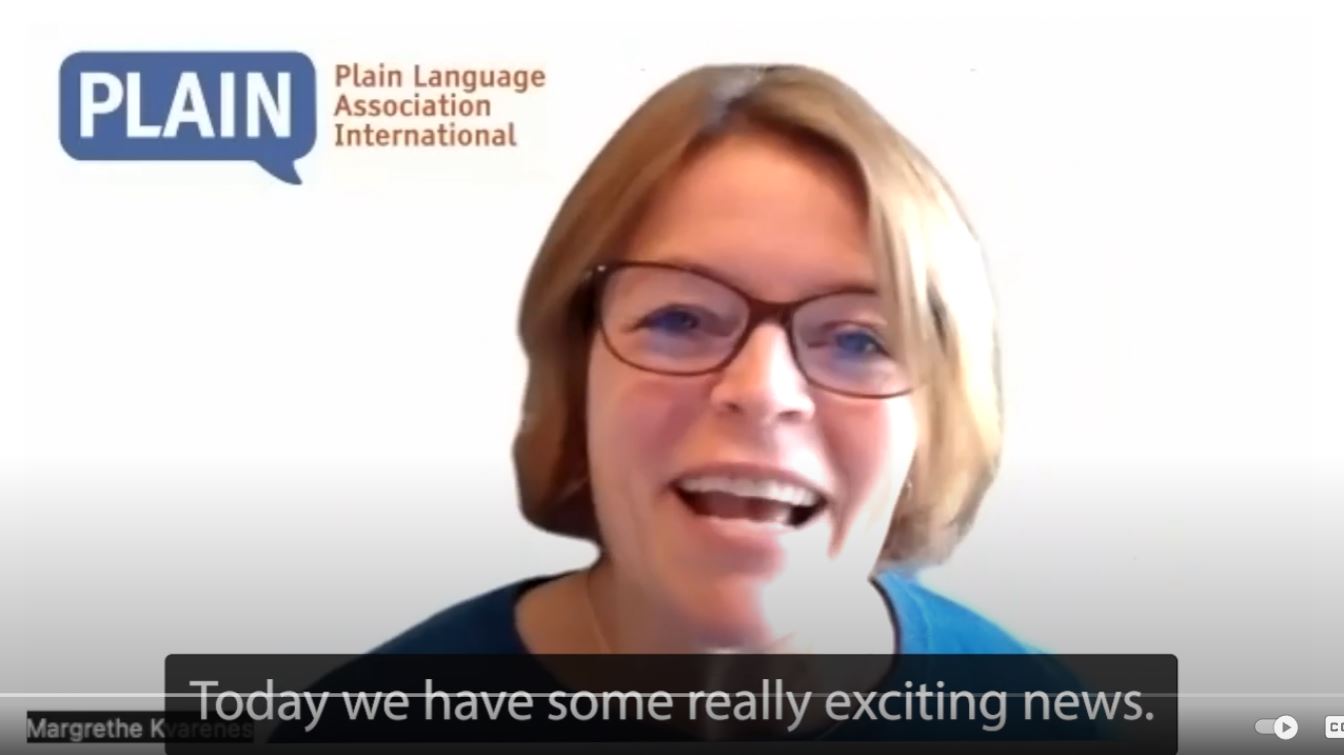
Margrethe Kvarenes update on PLAIN’s progress

At our most recent webinar, PLAIN President Margrethe Kvarenes gave a brief update on the progress the association has made.

“PLAIN’s focus right now is very much to get members from different parts of the world and different language areas, and help them to build a stronger culture for plain language in their region. When we actively seek diversity like this, we get new and valuable perspectives and plain language knowledge spreads.”

[presto_player id=2785]

Categories
News

E-journal call for contributions — Showing results

How can we convince our colleagues that implementing plain language is worth the effort? Many of us intuitively understand the benefits. But we also need concrete data and examples to help build the case for plain language as a powerful tool.

The next issue of PLAIN’s e-journal will focus on showing results.

We are looking for contributions from colleagues around the world who have documented the effects and benefits of plain language. Articles could cover any aspect of this, such as:

  • evidence-based research
  • case studies
  • best practices for measuring the impact of plain language.

We also welcome ideas for interviews with experts and book reviews that are relevant to this topic.

Articles should be short pieces of 800 to 1,000 words. They are all published in English, although we prefer to include a second version in the author’s own language where that is not English.

We aim to include a broad range of perspectives on this topic across different regions, industries, and practices. You do not have to be a member to contribute to the e-journal, but members’ submissions (as well as first-time contributors) will be prioritized.

Contributions are due in November. The issue will be published in early 2023.

If you are interested in submitting an article, please send a message with a summary of your article to publications@plainlanguagenetwork.org.


Categories
Uncategorized

Brigitte Quintero becomes PLAIN Ambassador

Brigitte is a social communicator and a theater actress. She’s the leader of the plain language strategy in Colombia and the Directorate of Participation, Transparency and Citizen Service of the Administrative Department of the Public Function of Colombia, an entity that leads the National Policy of Citizen Service, the birthplace of plain language.

Founding member of the Colombian Plain Language Network, co-author of pedagogical tools and plain language guidelines. In love with the public sector and the collaborative construction of a State that is increasingly inclusive and closer to the needs of the people.

Categories
News

New membership options

We are pleased to announce several initiatives that members voted for at the 2021 annual general meeting.

Reduced fees for members from lower-income countries

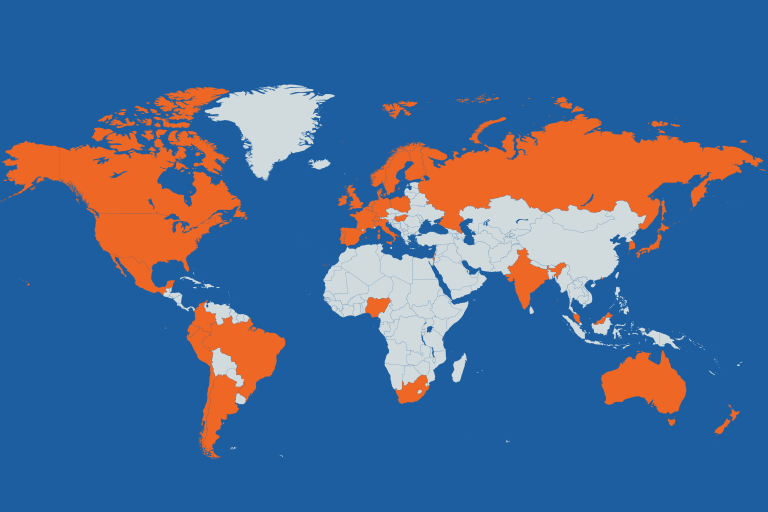
We understand that the cost of membership can be an obstacle to joining for some regions and we are offering reduced membership fees to new and existing members in those regions. PLAIN aims to serve a diverse, representative membership community. We already connect members from over 30 countries with a high proportion of members located in higher-income countries.

We hope that this change will: 

  • enable broader access to plain language networks and resources for everyone 
  • give support to plain language movements around the world. 

We have based our determination on the World Bank index of GDP per capita, which divides the world into 3 zones.

Zone

World Bank description

Includes (not an exclusive list)

Zone 1

High-income countries

The United States, Canada, most of Europe, Australasia, Singapore, Japan and South Korea

Zone 2

Upper-middle income countries

Most of South America, Mexico, most of Asia, some of Europe, some Pacific Island and Caribbean nations

Zone 3

Low and lower-middle income countries

Most of Africa, some of Asia, some Pacific Island nations

Zone 2 country membership fees will be reduced to USD 40/year

Zone 3 country membership fees will be reduced to USD 25/year

The reduced fees will only apply to individual memberships and not to organizational, student, and group memberships. Fees for Zone 1 members will not change. 

Group memberships for organizations

Group membership enables organizations of various sizes to join PLAIN and provide the benefits of membership to a number of their employees or colleagues for less than the cost of each joining PLAIN individually.

We are offering 4 levels of group membership:

  • Tier 1 – $150/year, up to 5 members
  • Tier 2 – $250/year, up to 10 members
  • Tier 3 – $450/year, up to 20 members
  • Tier 4 – $700/year, unlimited members.

How does group membership compare to existing forms of membership? 

PLAIN currently offers two forms of organizational membership – Organizational and Enhanced Organizational membership. In both cases, the membership is a single membership – only allowing for one email address, one member identity, and one set of member benefits. By comparison, group membership allows a number of members of an organization to have all the benefits of individual membership. 

Automatic renewal of membership fees

Next time you renew your membership you will be asked to register for automatic renewal and provide your credit card details. This is a once-only process. From then on, your membership will be renewed automatically, based on the details you have provided. Members can end their membership any time by cancelling automatic renewal payment. Cancelling is easy and membership will continue up to the set renewal date. 


See our Membership types and benefits page for a full overview of all options for PLAIN membership.

If you have any questions, please send us a message at membership@plainlanguagenetwork.org

Categories
News

A court closer to its citizens with Judge Lola from Argentina

From Europe in February to South America in July. Join us for our second webinar where we enter the world of legal language and catch up with Judge Lola from Buenos Aires. In this webinar PLAIN host Lodewijk van Noort will interview Judge Lola on the role of plain language in building an open, online, and model court.

When: Tuesday July 19, 2022
What time: 14:00 – 15:30 Central European Time
About: A court closer to its citizens with guest, Judge Lola from Argentina

This webinar is free to our members.

Register here

What is this webinar about?

In this webinar PLAIN host Lodewijk van Noort will interview Judge Lola about the role of plain language in building an open, online, and model court in Buenos Aires.

Traditionally, we don’t expect judges to make efforts to be closer to citizens. Yet, this is what Judge Lola and her project team set out and managed to achieve a few years ago. Judge Lola will tell us about the steps she took that transformed the court and how it now interacts with citizens.

Come be inspired:

  • The Organization for Economic Co-operation and Development has recognized their work.
  • A single vision unites the work team in building an open and transparent court.
  • Find out how courts can foster innovation, transparency, collaboration, and participation with citizens.

The main presentation will be in English. After the interview and discussion PLAIN members can join 1 of 3 breakout rooms:

  • Discuss with members from her working group, the Observatorio de Lenguaje Claro, facilitated by Natalia Torro (Spanish & English)
  • Share experiences of plain language in legal businesses (English)
  • Chat over coffee for networking (English)

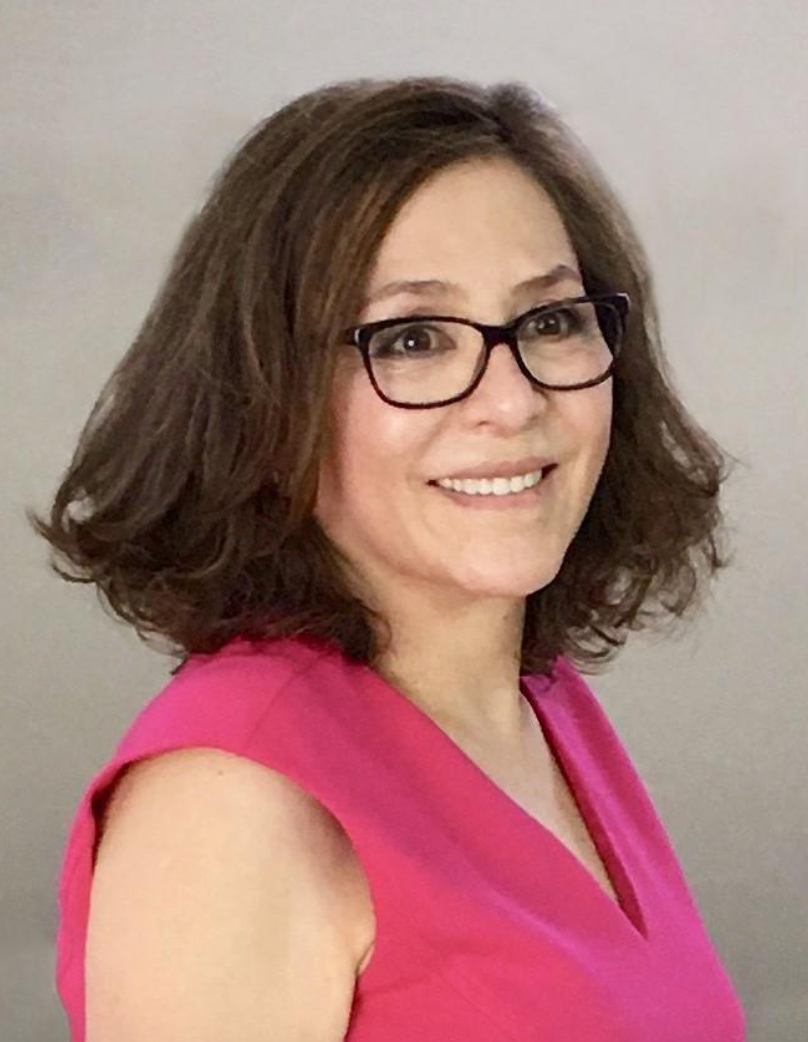
Meet Judge Lorena Tula del Moral (Judge Lola) and her team in Argentina.

Lola earned her Law Degree from University of Buenos Aires, and has specialized in Administration of Justice. She is the director of the Observatorio de Lenguaje Claro of the Law School of University of Buenos Aires. She is a judge of the Criminal Court No. 13 of the City of Buenos Aires, and has written several publications.

Categories
Uncategorized

New PLAIN Ambassador in Ecuador, Mónica Yepez

In her career as editor, teacher, advisor, and lawyer, she has seen the negative effects of traditional writing on an individual, institutional and social scale. For this, she has seen the need to innovate writing. In 2018, she created the Fundación Escribir, which projects, Proyecto Lenguaje Claro and Proyecto Nacional de Escritura, seek to transform communication and education, respectively.

One of her current functions is to design and impart plain language courses for mediation centers, companies and professionals from the public and private sectors.

She is doctor in jurisprudence (U. Catolica del Ecuador) and has a master’s degree in education and in the teaching of writing (University of Maine, USA).

Categories
News

Plain language projects in the Open Government Partnership

Commitments to plain language around the world

The Open Government Partnership (OGP) is an organization of reformers working to transform how government serves its citizens. Its main goal is to promote transparent, participatory, inclusive, and accountable governance. Currently 77 countries, 76 local governments, and thousands of civil society organizations are members of the OGP.

A number of countries in Europe and the Americas have defined plain language as a powerful tool to achieve more transparency, participation, inclusiveness, and accountability in governance. These countries have made commitments in their national OGP action plans. Thirty-six commitments mention “plain language”, “clear language”, “accessible language”, or their Spanish equivalents. Most focus on making legislation, regulation, or administrative documents and forms publicly available in a plain language format. Some commitments are broad, applied to government documentation in general, while others are specific to sectors.

Here are some examples of commitments: 

Chile, 2016: “Energy Sector Watch”

Chile committed to making information about the energy sector, including data, statistics, public policy, plans, and strategy, more accessible. As part of this initiative, certain energy sector information was made available in plain language in order to better facilitate citizen engagement.

Norway, 2013: “Plain Legal Language”

Norway committed to re-examining pieces of legislation that are important to citizens and reformulating them in plain language. They also planned to create a methodology to draft new legislation or revise old legislation in plain language format. Finland also made a similar commitment in 2013.

Luxembourg, 2019: “Promotion et sensibilization de l’utilisation d’un langage administratif clair et compréhensible”

Luxembourg plans to train administration officials to use plain language in public-facing administrative documents. In the future, this training will be part of a continuing education program on clear and understandable communication for administration officials.

The Netherlands, 2020: “Implement plain language initiatives

The Netherlands is creating a Plain Language Brigade to advocate for the publication of plain language government information. The program will help to ensure that Dutch citizens have access to clear, digitized information about public services.

Albania, 2020: “Publish accessible budget information online for citizen engagement” and “Improve reporting on public finance information

Albania will publish accessible information about both the budget and other public finance plans in plain language.

Lithuania, 2021: “Assessing Impact of Draft Decisions and Making the Results Publicly Available

Lithuania will provide clear and comprehensible public information about the expected benefits and costs of potentially greater-impact legislation under the government’s consideration, and underlying reasons for the specific decisions.

Find the full list of commitments related to plain language here (downloads an Excel spreadsheet)

Do you want to get involved? 

If your country has already made commitments, you can make contact and ask how to contribute or advise. You find the contact details of national and local members on OGP’s web site. If your country has not made commitments yet, you could contact your national or regional authorities and start advocating, inspired by the commitments from other countries.


Categories
Uncategorized

PLAIN Ambassador Antonio Martin

PhD. In Spanish Philology, CEO of CÁLAMO&CRAN, PUBLISHNEWS and EnClaro (Spanish Plain Language). Member of PALABRAS MAYORES. Co-founder of UniCo and SEA (Spanish Editors Association). Honorary member of La Casa del Corrector, of the Litterae Foundation. Co-author of El libro rojo de C&C (C&C, Madrid, 2013), 199 recetas infalibles para expresarse bien (Vox, Barcelona, 2015), Dilo bien y dilo claro (Larousse, Barcelona, 2017), and author of La mano invisible: confesiones de un corrector iconoclasta (CSIC, Madrid, 2019). He is a passionate and entertaining teacher, and an enthusiastic communicator of language.

Categories
News

2022 Clarity International Conference

Call for Papers!

Clarity International, one of our fellow Plain Language organizations, dedicated to legal language, will hold its conference in Japan and has opened a call for papers. Check out the details below.

Theme

Achieving understanding and cooperation through communicating with clarity and fairness – Towards a sustainable society

Diversity and inclusion are shared values in the global society. Plain language plays an important role in creating a global society that is diverse, inclusive and accepting of different values.
It does that by enabling smooth communication without misunderstandings, across the whole of society, irrespective of nationality, sex, age, religion and culture.
The goal of the 2022 Clarity International Conference is to promote effective communication through plain language that is accessible to all.

Format

The conference will be held in person but may be changed to online depending on the status of immigration restrictions in Japan as of June 20, 2022.

To realize a sustainable society and promote DX, the conference will be paperless as far as possible.

English will be the primary language for the conference. There will be no interpreters, but a web conferencing system with a simultaneous interpretation function will be available. Do not miss a plain language demonstration experiment that is highly compatible with digitalization.

Several sessions will show how plain language is highly consistent with DX and AI.


Call for Papers in Four areas

Law | Business | Society | Applications and Technologies

Law

Plain legal language helping build a diverse, inclusive global community. Your submission could focus on:

  1. Plain language best practice examples and solutions in developed countries where governments are promoting plain language for public-facing communication.
  2. The use of plain language in the legal system.
  3. Plain language legislation around the globe.
  4. Issues in translating Japanese laws.
  5. Plain contract language.
  6. Online terms & conditions, and personal information disclosures.
  7. Multilingual considerations for plain language legal documents.
  8. Plain language in commercial law, consumer-protection law or other areas of law.
  9. Design thinking in legal communications.
  10. Crisis & emergency notifications to foreigners in your country.

Business

Plain language essential for Environment, Society and Governance (ESG) initiatives. Your submission could focus on:

  1. Doing business in plain language.
  2. Financial and non-financial transparency.
  3. Addressing the need for clear, concise communication.
  4. Plain language for corporate governance & investor relations.
  5. Digital transformation in the sphere of plain language.
  6. Insurance industry initiatives.
  7. Initiatives for plain language at government agencies and corporations.
  8. Universal design.

Society

Plain language essential in achieving Sustainable Development Goals (SDGs). Your submission could focus on:

  1. SDGs and plain language.
  2. Plain language initiatives supporting immigrants, tourists, and foreign residents.
  3. How law enforcement, court, and medical situations benefit from plain language.
  4. Business implications for the ISO plain-language standard.
  5. Democratization of language:  clear and transparent communication helps to meet the diverse needs of a society.

Applications and Technologies

Services and technologies associated with plain language. Your submission could focus on:

  1. Plain Language in the Age of AI:  plain language for AI & machine translation.
  2. Plain language in the FinTech industry.

Schedule

Call for Papers Opens: February 18, 2022 (Friday)

Call for Papers Closes: April 18, 2022 (Monday)

Decisions Made: No later than June 1, 2022 (Wednesday)

Speaker Agreements Due: No later than July 1, 2022 (Friday)

Speaker Photos and Bios Due: No later than July 29, 2022 (Friday)

Final PowerPoints Due: July 29 , 2022 (Friday)

More Info

Find out more here: https://clarity-tokyo.jp/